Numerical Simulations
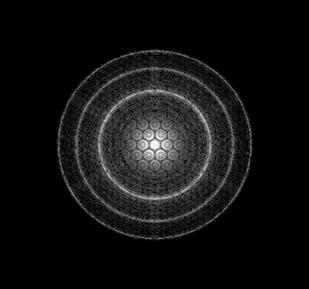
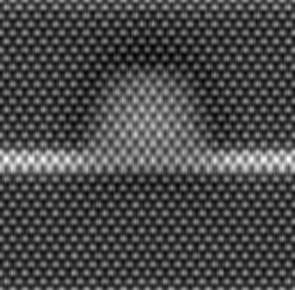
In order to interpret images and diffraction patterns obtained from a (scanning) transmission electron microscope ((S)TEM), numerical simulations often need to be performed. Over the years, my students and I have prepared a number of utilities and software programs to perform these simulations using the multislice method. Feel free to download these programs and utilities, but remember that anything free comes with no guarantee.
DISCLAIMER
The computer code and or data in these files is provided for demonstration purposes only with no guarantee or warranty of any kind that it is correct or produces correct results. By using the code and or data in these files the user agrees to accept all risks and liabilities associated with the code and or data. The computer code and or data in these files may be copied (and used) for non-commercial academic or research purposes only, provided that this notice is included. These files or any portion of them may not be sold or rented under any circumstances.
Program zoneaxis
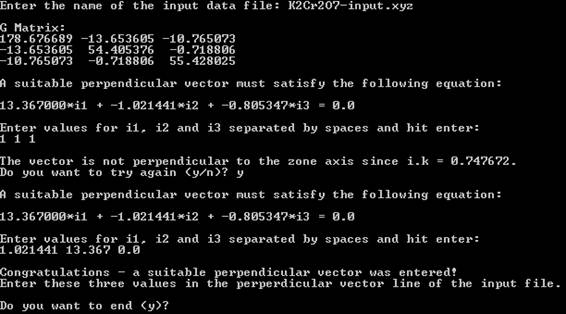
This is a small program that will transform any crystal system into Cartesian coordinates at any desired zone axis. The documentation is included in the zip file.
Click anywhere on this line to download the zoneaxis program files in a compressed ‘.zip’ format.
Please refer to this work as: M. D. Robertson and K. Raffel, Microscopical Society of Canada Bulletin – Société de Microscopie du Canada Bulletin, 36(1), 13 (2008).
Program Lattice Geometry
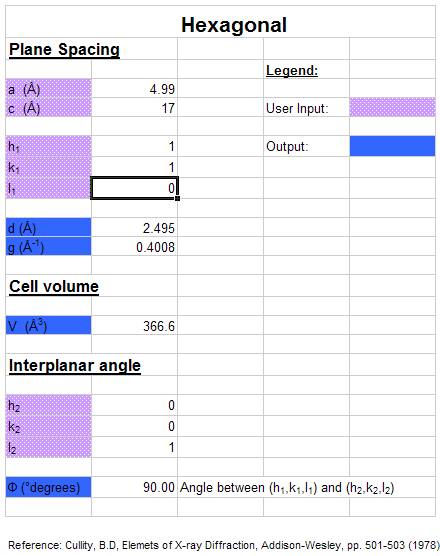
This download contains an EXCELTM spreadsheet useful for calculating the length of a vector and the angle between two vectors for any of the seven Bravais lattices. The documentation is included in the zip file.
Please refer to this work as: E. Machan, C. Parsons and M. D. Robertson and K. Raffel, Microscopical Society of Canada Bulletin – Société de Microscopie du Canada Bulletin,37(2), 13 (2009).
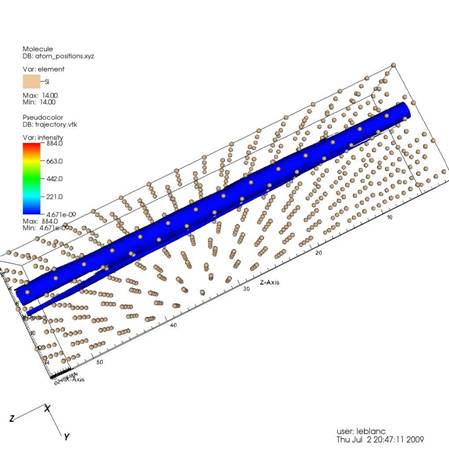
Program Electron Trajectory Visualization
This download contains programs that can be used to visualize the trajectory of an electron in a scanning transmission electron microscope as it propagates through a material. The documentation is included in the zip file.
Please refer to this work as: M. LeBlanc and M. D. Robertson, Microscopical Society of Canada Bulletin – Société de Microscopie du Canada Bulletin, 37(2), 20 (2009). In addition, please cite: E.J. Kirkland, Advanced Computing in Electron Microscopy, Plenum Press, New York (1998) since these programs use his multislicing engine in the computations.
Program McMaster Summer School 2013
These files contain documentation and programs for the serial and parallel calculation of TEM and STEM images and diffraction patterns using the multislice method. In addition, the lecture notes in PDF and PowerPoint formats have been included. Please contact me to receive these files if you are interested!